Best Cannabis POS Software 2026: Dispensary Buyer Guide
Best cannabis retail software 2026 — compare dispensary POS options on offline checkout, scale pricing, compliance, and total cost. Practical buyer checklist.

If you’re shopping for dispensary point of sale software in 2026, the market looks nothing like it did even two years ago. Generic platforms have bolted “cannabis mode” onto retail cores that were built for t-shirts. Legacy seed-to-sale vendors still ship desktop-era interfaces. And a new crop of specialty POS systems — Budy included — has started treating dispensary workflows as the primary design target, not an afterthought.
That’s good news for operators. It’s also made the buying decision harder. This guide walks through the ten criteria we think actually matter when evaluating the best cannabis POS software, the trade-offs each one hides, and how to sanity-check any vendor’s claims before you commit.
Best software for running a cannabis dispensary
The best software for running a cannabis dispensary is the one that treats the shop floor as the product: a live scale in the cart, strain and batch on the item, compliance written at the sale, and a till that still rings when the connection drops. Generic retail software can be bent toward that. A purpose-built system starts there. The ten criteria below are how to tell the two apart before you sign. If you already have a shortlist, the Budy comparison pages put Dutchie, Flowhub, and Loyverse against that same list.
Choosing dispensary point of sale software
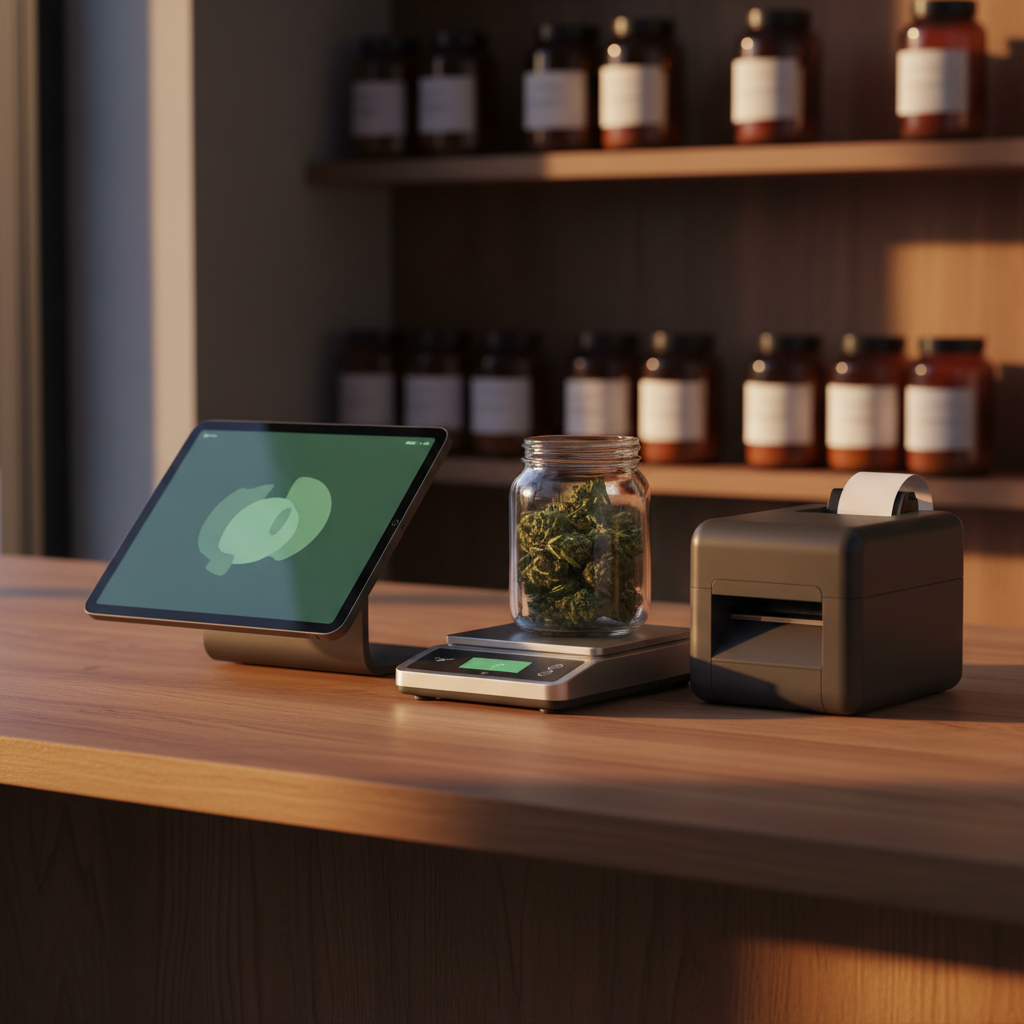
Dispensary POS systems are the counter a cannabis shop actually sells from: the till, a live scale, and a label printer. A cannabis POS system is what makes that counter a weighed sale — grams streamed into the cart, strain and batch on the line item, compliance written before the receipt, and a till that still rings when the connection drops. Generic retail software can be bent toward that. A purpose-built system starts there. If you already have a shortlist, the Budy comparison pages put Dutchie, Flowhub, and Loyverse against the same list.
Why cannabis retail needs its own POS
A cannabis dispensary is not a retail boutique. You sell a product that has to be weighed to the tenth of a gram. You track inventory at the batch level for compliance. You run age verification on every sale. Your margins move with strain supply, not with seasonal fashion. Your staff onboards dozens of new SKUs a month and has to translate THC percentages for a customer who walked in knowing only the word “hybrid.”
A generic retail POS can be forced to cover some of this. The question is whether you want to spend your first six months forcing it. A purpose-built cannabis POS — the kind you’d consider “best in class” — handles these workflows natively.

The ten criteria for the best cannabis POS
1. Weight-based pricing with live scale integration
If your store sells flower by the gram, the scale is part of the transaction. A cannabis retail POS that makes you type grams into a text field is a cannabis retail POS that will quietly create hours of reconciliation work every month. Look for native Bluetooth scale support — Acaia Lunar, Acaia Pearl, Acaia Pyxis — with the weight streaming straight into the line item and per-gram pricing calculated automatically.
Sanity check: ask the vendor for a 30-second video of a flower weigh-out. If they can’t produce one, the integration isn’t real.
2. Strain as a first-class entity
Cannabis POS software needs a proper Strain model — not a generic “product variant.” Strains have genetics, THC/CBD percentages, lab-test dates, effects, terpene profiles, batch/harvest data, and imagery. These fields must be queryable, reportable, and translatable, not crammed into a description text blob.
3. Compliance logging that writes itself
Every cannabis-legal jurisdiction requires per-sale records: what was sold, to whom, when, from what batch, by which staff member. The best cannabis POS software captures this at the moment of sale automatically. You should never be reconstructing compliance data from paper slips.
4. Offline-first architecture
Cloud-only POS platforms drop the moment your ISP hiccups. A real offline-first cannabis dispensary POS keeps working for hours or days without internet — local database, local auth, local hardware. Budy uses ObjectBox as the primary database on every device; the backend is a sync target, not the system of record. See our Budy vs Loyverse comparison for how this plays out on the shop floor.
5. Multi-terminal real-time sync
A single-terminal POS is only viable for a one-budtender shop. Any dispensary with two or more tills needs live sync between devices — inventory decrements, open tickets, member lookups — all visible on every terminal within a second of the change. Offline-first and multi-terminal sync are not the same feature, and you need both.
6. Member profiles, loyalty, and repeat-purchase tools
Dispensaries live on repeat customers. Look for member records tied to purchase history, age-verification-on-file, points or tier-based loyalty that applies at checkout automatically, and cart-aware offers (not just flat percent-off coupons).
7. Multi-location and multi-tenant architecture
Even if you run one store today, buying a POS that assumes you’ll stay at one store forever is a trap. The best cannabis POS software separates master catalogue from store instance, lets you push pricing rules top-down or bottom-up, and syncs member databases across locations. Multi-location dispensary management should be a configuration, not a migration.
8. Label printing and barcode scanning
Cannabis compliance often requires printed labels on jars and packages — strain, weight, batch, SKU barcode. Your POS needs native thermal label printer support (Niimbot is our default) with editable templates, and scanner input that works with whatever barcode hardware you own. See the Bluetooth scale and label printer integration guide for how this stitches together.

9. Modern AI features that actually save time
Agentic AI is the single biggest shift in retail software in 2026. The best cannabis POS platforms use it for three concrete jobs: onboarding new products from a photo (the AI Smart Scanner), auto-translating menus for bilingual stores, and pulling strain metadata from grounded web research. If a vendor’s “AI” amounts to a chatbot that summarizes yesterday’s sales, that’s not AI — that’s a feature a spreadsheet has had since 1985.
10. Honest pricing and exit terms
A POS that locks you into a proprietary payment processor, hardware bundle, or multi-year contract is not your friend. Ask about data export, hardware portability, cancellation, and whether your member database is something you can walk out the door with.
At-a-glance: what a specialty cannabis POS delivers vs a generic POS
| Criteria | Specialty cannabis POS | Generic retail POS |
|---|---|---|
| Weight-based pricing + live scale | ✓ | ✗ |
| Strain as a first-class entity | ✓ | ✗ |
| Compliance logs per sale | ✓ | Partial |
| True offline-first mode | ✓ | Cache only |
| Real-time multi-terminal sync | ✓ | Varies |
| Member and loyalty tools | ✓ | Basic |
| Multi-location architecture | ✓ | Add-on |
| Label printer + scanner support | ✓ | Receipt only |
| Built-in AI agents | ✓ | ✗ |
| Exportable data + no processor lock-in | ✓ | Varies |
Not every cannabis POS that markets itself as “specialty” actually clears all ten. The point of the table isn’t to score vendors — it’s to give you a checklist to press each one against during a demo.
Best cannabis retail software 2026: POS is only one layer
“Cannabis POS” and “cannabis retail software” get used interchangeably, and that’s where a lot of buying decisions go wrong. The till is one layer of four, and a vendor can be excellent at one while being an afterthought at the rest:
- The POS layer — the sale itself: cart, weight, discounts, payment, receipt. This is what demos show.
- The inventory layer — batch-level stock, transfers between rooms and stores, shrinkage, purchase orders, and the reconciliation that follows every weigh-out.
- The customer layer — member profiles, age verification on file, loyalty balances, and the offers that apply themselves at checkout.
- The intelligence layer — reporting that answers “which strains actually earn shelf space”, plus menu and label output that stay in sync with what’s in stock.
The best cannabis retail software in 2026 is the platform where those four layers share one data model rather than being stitched together with nightly exports. When they’re separate products, the seams show up as the work you do at closing: the manual stock count, the CSV upload, the menu board that’s a day behind the shelf.
A practical test during evaluation: change the price of a single strain and watch how many places you have to touch. In an integrated system it’s one edit that reaches the till, the labels, the online menu, and the in-store TV menu board. In a stitched-together stack, it’s four systems and a phone call — and that’s on a quiet Tuesday, not a Friday night.
What to ask in a demo
Three questions cut through most marketing.
- Can you show me a flower weigh-out, right now, on real hardware? If the scale integration is native, this takes two seconds. If it isn’t, you’ll get a five-minute detour about “partner certification.”
- What happens when the internet drops? Make them disconnect the Wi-Fi during the demo. A real offline-first cannabis POS will shrug; a cloud-only one will show a spinner.
- Show me how a new SKU gets onboarded. Watch for manual typing vs an AI-assisted flow. Over a year, this difference is measured in staff-days saved.
Where Budy fits
We built Budy because the cannabis POS software we saw in the field was either generic retail bent into cannabis shape, or compliance-first systems that treated the shop floor as secondary. Neither works well under a Friday-night queue.
Budy ticks all ten criteria on this list: native Acaia scale integration, first-class Strain entity, real-time compliance logging, ObjectBox-backed offline mode, multi-terminal sync, member loyalty, multi-tenant architecture, Niimbot label printing, a working AI Smart Scanner, and exportable data with no payment-processor lock-in. The cannabis dispensary POS overview walks through how those pieces meet on the shop floor, and operators in Thailand should start with the Thai dispensary page, where PT 33 verification is part of the sale.
That said, we’re honest about where we’re still growing: third-party integration marketplace depth, legacy community resources, and niche regional compliance modules are areas where older vendors have a lead. For most operators in 2026, the trade is worth it.
Frequently asked questions
What is the best software for running a cannabis dispensary? There is no universal winner. The best software for running a cannabis dispensary prices flower by weight from a live scale, keeps strain and batch on the product, writes compliance at the sale, and keeps checkout working offline. Compare vendors on those jobs at the Budy comparison pages.
What are dispensary POS systems? Dispensary POS systems are the counter a cannabis shop sells from: the till, a live scale, and a label printer, tied to software that prices flower by weight and writes compliance at the sale. Generic retail systems can be bent toward that. A purpose-built one starts there. Compare how Dutchie, Flowhub, and Loyverse handle those jobs on the Budy comparison pages.
What is dispensary point of sale software? Dispensary POS software prices flower by weight from a live scale, keeps strain and batch on the product, writes compliance at the sale, and keeps checkout working offline. Those are the jobs to press in a demo. The Budy comparison pages line Dutchie, Flowhub, and Loyverse up against that list.
What is the best cannabis retail software in 2026? There is no single winner — the right answer depends on whether you sell by weight, how many locations you run, and how much downtime you can absorb. The shortlist criteria that matter in 2026: weight-based pricing with a live scale, strain as a first-class entity, automatic compliance logging, true offline-first operation, real-time multi-terminal sync, member loyalty, label printing, and honest exit terms.
Which cannabis POS is easiest for budtenders to learn? Judge it by how a new SKU gets onboarded and how many taps a weighed sale takes, not by the length of the feature list. A budtender-friendly POS puts the scale reading, the label print, and the compliance capture on the same screen as the cart, so a weighed sale is one flow rather than three. Ask for a live weigh-out during the demo and count the taps yourself.
Does cannabis POS software handle age verification and compliance tracking? A purpose-built one does, at the moment of sale rather than afterwards. Every cannabis-legal jurisdiction requires per-sale records — what was sold, to whom, when, from which batch, by which staff member — and the POS should write that automatically. If you are reconstructing compliance data from paper slips or a spreadsheet at month end, the system is not doing its job.
What does cannabis POS software cost? Pricing models vary from per-terminal licences to revenue shares tied to a payment processor. Budy is one plan: two months free, then you contact us for pricing — per store, not per device or per user, with every feature and integration included. Whatever vendor you pick, ask what happens to your member database and sales history if you leave. Full detail on the pricing page.
Is there free dispensary software? Free tiers usually mean a crippled feature set, a per-transaction cut, or a hard cap on products or terminals. Budy has no lite version: the two free months are the full product on every device, and from day 61 you contact us for pricing. Nothing is charged automatically. Treat any permanently free cannabis POS as a question about where the revenue actually comes from.
Can one POS handle multiple dispensary locations? It should, and you should buy for it before you need it. Multi-location dispensary management ought to be a configuration change, not a migration: a master catalogue separate from each store instance, pricing rules pushed top-down or bottom-up, and a member database that syncs across sites so a customer is recognised at any of your stores.
The short version
The best cannabis POS software in 2026 is the one that treats cannabis as the primary use case — not as a skin on a retail core, and not as a compliance form with a cash drawer attached. Weight-based pricing, strain-first modelling, offline resilience, multi-terminal sync, loyalty, labels, AI, and honest pricing. Press every vendor you evaluate against those eight things.
If you want to see what this looks like in practice, get in touch and we’ll walk you through a live demo on real dispensary hardware. The AI Smart Scanner deep dive and the Bluetooth scale integration page are good starting points for the features we’re proudest of.