Dispensary POS Software Cost in 2026
Dispensary POS software cost in 2026: platform fee, hardware, processing, terminals — what you pay and what you can skip.

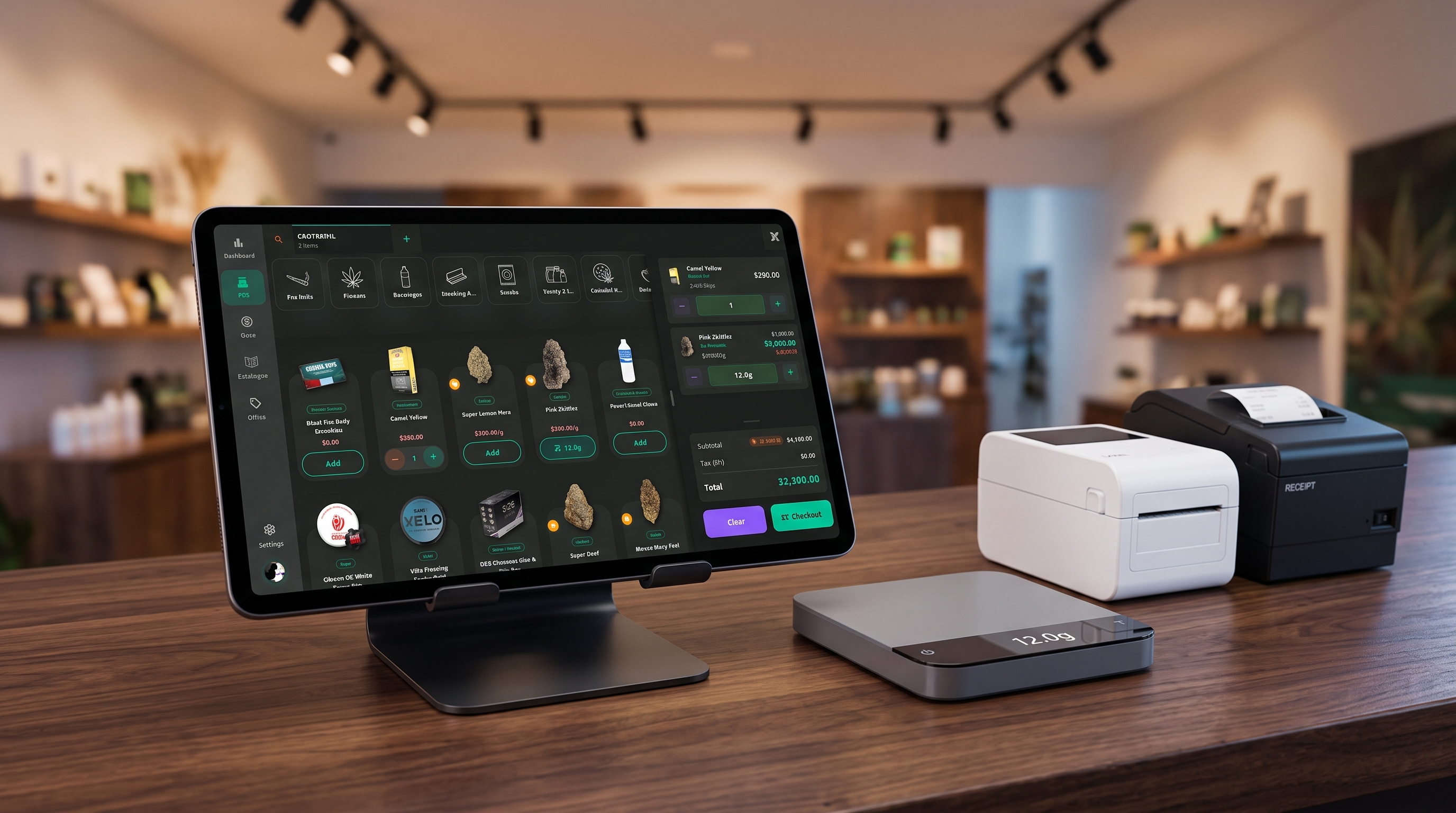
Ask what dispensary POS software costs and you will get a demo booking. That is the whole category’s answer, and it is not an accident. Cost in this market is spread across five separate lines, only one of which appears on a pricing page, and the four you cannot see are usually the ones that decide your annual number.
This is our attempt at the straight version. Where we have a real gap, it is named. Where a competitor’s model is genuinely better for some shops, that is said too.
One note on competitor figures before we start. Published list prices for the major US dispensary platforms in 2026 sit in the several-hundred-dollars-a-month-per-location band, with hardware bundles quoted in the low thousands per register. We are deliberately not printing a specific vendor’s number here, because those move without announcement and a stale figure in an evergreen post is worse than no figure at all. Get a current written quote, and read the term length on it.
The five places the money actually goes
1. The platform fee
The advertised number. Usually per location, sometimes per location with tiers based on revenue or SKU count.
The question worth asking is not what the fee is but what it scales with. A fee that scales with locations is predictable. A fee that scales with terminals punishes you for putting a second till on the floor at Christmas. A fee that scales with revenue means your good year is also the year your software bill jumps, which is a strange incentive to sign up for.
2. The hardware bundle
This is where the first-year number usually doubles. Vendor-supplied registers, printers, scanners and cash drawers get quoted per station, and in this category that quote commonly lands in the low thousands per register.
Some of that is real value. A bundle that arrives configured, imaged and supported saves a genuine week of setup, and if you are opening three stores at once that week is worth paying for.
The part to look at hard is whether the hardware is a requirement or an option. Required hardware is a capital cost and a switching cost at the same time. It is much harder to leave a vendor when leaving strands four thousand dollars of terminals that only run their software.
3. The payment-processing cut
The largest line, and the one least often compared properly. When a POS vendor owns the payment processing, the software fee is not really the price. The spread on every transaction is.
Do this arithmetic before you sign anything. Take your actual monthly card volume, apply the quoted rate, and put that number next to the platform fee. For a lot of dispensaries the processing line is several times the software line. It is also the line that gets quoted as a decimal so small it does not feel like money.
Low-ticket items make this worse. A shop that moves a lot of pre-rolls and single-gram sales is paying per-transaction fees against small baskets, which is the least efficient shape a percentage-plus-fixed-fee model can be applied to.
4. Per-terminal and per-user licences
Two tills, two licences. A seasonal staff member, another seat. These are individually small and collectively the reason the invoice does not match the pricing page.
The operational cost is worse than the financial one. Once a licence has a price, somebody starts managing around it: staff share logins, a second till does not get opened on a busy Saturday, a new hire uses somebody else’s account for a week. Every one of those is a compliance problem wearing a cost-control disguise.
5. The lines nobody quotes
Setup and onboarding fees. Data migration, sometimes charged by the hour. Integration fees per connected system. Minimum contract terms, which are not a fee but function as one the moment you want to leave. And the cost of exit itself: what happens to your member database, your sales history and your batch records if you go elsewhere.
Ask about the last one first. A vendor who answers it cleanly is telling you something useful about the other four.

Which of those are avoidable
Three of the five are structural to how a vendor makes money, and three are avoidable if you choose a vendor whose model does not include them.
| Cost line | Budy | Typical dispensary platform |
|---|---|---|
| Platform fee | Contact us after two free months | Several hundred per location, per month |
| Setup or onboarding fee | None | Common |
| Per-device licence | None | Common |
| Per-staff-account fee | None | Sometimes |
| Cut of your sales | None | Common where the vendor owns processing |
| Required hardware bundle | None | Common |
The right-hand column describes the shape of the category rather than any one vendor, and it was written in August 2026. Treat it as a checklist to press a quote against, not as a scorecard.
What you should actually expect to buy
Separating the software question from the hardware question makes both easier to answer.
| Item | What it does | Required |
|---|---|---|
| Android tablet, iPad or Windows PC | Runs the till | Yes usually already owned |
| Bluetooth scale | Per-gram pricing off a live weight | Only if you sell by weight |
| Thermal label printer | Strain, batch and compliance labels | Only if you print labels |
| Receipt printer and cash drawer | Paper receipts, cash handling | Optional |
| Barcode scanner | Faster intake and packaged goods | Optional |
At the time of writing, August 2026, an Acaia Bluetooth scale was around USD 120 and a Niimbot thermal label printer around USD 80, bought from the manufacturer. Those are the two pieces we would actually recommend a flower-selling dispensary buy, and the hardware catalogue lists what we have tested rather than what we resell. The Bluetooth scale page and the label printing page cover what each one changes at the counter.
On “free dispensary software”
Free tiers exist. They are paid for somewhere, and the three common places are worth knowing.
A capped feature set. Free until the thing you need is behind the upgrade, which is usually discovered after your catalogue and member database are already inside. The cap tends to sit on exactly the features a growing shop reaches for: multi-location, reporting, integrations.
A hard limit. Products, terminals, transactions or staff. Cleaner than a feature cap because you can see the wall coming, and worth checking whether the limit is one you would hit in year one or year four.
A revenue share. Free software, mandatory processor. This is the most honest of the three in a sense, since the vendor is genuinely earning, but it is the model where the true cost is hardest to compare, because it depends on your volume rather than on a published number.
None of those is dishonest by itself. The test is whether you can say out loud where the vendor’s money comes from. If you cannot, do not build your store on it.
What Budy costs, straight
One plan. Two months free with every feature on every device, then contact us for pricing.
Per store, not per terminal, not per staff account, not per SKU. No setup fee, no onboarding fee, no minimum term, no cut of your sales. Run four tills and a TV menu board in one shop and the number does not change. Full detail is on the pricing page.
Everything is in it, because there is nothing else to sell you: Metrc and BioTrack reporting, per-gram pricing from a Bluetooth scale, batch and lot traceability from goods-in through to the printed receipt, age verification before payment, daily and monthly purchase allowances with recorded manager overrides, the AI product scanner, a strain library of over seven thousand profiles, label printing, loyalty with points and tiers, multi-location, and clients for Android, iOS, Windows and Android TV.
Where paying more is the right call
We would rather write this than have you find it in month two.
If you need US cannabis tax broken out. Budy applies a single VAT-style rate per store today. State excise, local cannabis tax and sales tax as separate lines on one receipt is not something we do yet. If your jurisdiction requires that split, a vendor who has already built it is worth the higher fee, and this is the single most common reason a US dispensary should not pick us right now.
If you want payments in one throat to choke. We do not process payments. That means no revenue share, and it also means we cannot get you a rate, cannot subsidise the software fee out of interchange, and cannot take the call when a terminal declines. A bundled vendor can do all three. For some operators that is worth real money.
If your menu lives on the big marketplaces. We do not syndicate to consumer marketplaces and we do not do delivery dispatch. Several competitors do both, and if online ordering is a meaningful share of your revenue, that integration is not a nice-to-have.
If you need per-state compliance depth built over years. Platforms that have shipped in your state since 2018 have absorbed edge cases we have not. The Metrc compliance guide goes into what that actually means in practice.
Where we think the trade goes our way: the counter itself, and not being locked to anyone’s hardware. The Budy versus Dutchie and Budy versus Flowhub pages set those out side by side.
How to price a quote properly
Five minutes with a spreadsheet beats an hour of demo.
- Multiply the platform fee by locations and by 36 months. Three years is the honest horizon for a POS decision.
- Apply the processing rate to your real card volume, not to a round number. Use last year’s actual.
- Add required hardware per register, and count the registers you will have in year three, not year one.
- Add licences that scale with terminals or staff, using your busiest month rather than your average.
- Ask what leaving costs, in fees, in stranded hardware, and in what data you can take with you.
Then put the total next to the alternative. In our experience the ranking changes when you do this, and it changes most for shops with high transaction counts and low average tickets.
Frequently asked questions
How much does dispensary POS software cost? The category sits in the several-hundred-dollars-a-month-per-location band for the platform fee alone, before hardware, and the real total depends on four other lines: a hardware bundle usually quoted in the low thousands per register, a payment-processing cut on every transaction, per-terminal or per-user licences, and one-off setup or migration fees. Budy is one plan: two months free, then you contact us for pricing, with no setup fee, no per-device licence and no cut of your sales.
Is there free dispensary software? There are free tiers, and they are usually paid for somewhere you are not looking. The three common models are a capped feature set that forces an upgrade once you are dependent, a hard limit on products, terminals or transactions, and a revenue share collected through a bundled payment processor. None of those is dishonest on its own, but you should be able to say out loud where the vendor’s money comes from before you build your store on it. Budy has no permanently free tier and no lite version: two months of the complete product, then you contact us for pricing.
What is the cheapest dispensary POS system? The cheapest headline price and the cheapest system are rarely the same thing. Price the whole stack over three years: platform fee times the number of locations, hardware you are required to buy from the vendor, the processing spread applied to your actual ticket mix, licences that scale with terminals or staff, and the cost of leaving. A low monthly fee attached to a mandatory processor can cost more per year than a higher fee with no revenue share, particularly if you sell a lot of low-ticket items like pre-rolls.
Do I have to buy hardware from my POS vendor? With some vendors yes, and that is the line worth checking hardest, because a bundled register is both a capital cost and a switching cost. Budy runs on Android tablets, iPads, Windows PCs and Android TV, so the till itself is usually hardware you already own. The optional additions are an Acaia Bluetooth scale if you sell flower by weight and a Niimbot thermal label printer if you print your own labels, both of which you buy from the manufacturer and keep if you leave.
Does Budy take a percentage of my sales? No. Budy does not process payments and takes no cut of your transactions. That has a real trade-off attached: because we are not in the payment flow, we cannot negotiate a processing rate on your behalf or subsidise the software fee out of interchange the way vendors who own the processor sometimes can. You bring your own processor and keep the relationship. Whether that is cheaper depends on your ticket size and volume, and it is worth actually doing the arithmetic.
What does a single-store dispensary pay for Budy? The first two months are free, on every terminal and staff account the store runs. After that, contact us for pricing. Hardware is separate and optional: a Bluetooth scale and a label printer were around USD 120 and USD 80 respectively at the time of writing in August 2026, bought from the manufacturer rather than from us. There is no setup fee, no onboarding fee and no minimum term.
Does Budy handle US cannabis excise tax? Not yet, and this is the honest gap in the pricing conversation. Budy applies a single VAT-style tax rate per store today. A dispensary that has to break out state excise, local cannabis tax and sales tax separately on one receipt is not served by that, and if your jurisdiction requires that split you should treat it as a reason to look at a vendor who has already built it. Ask us where it stands before you sign rather than after.
The short version
The platform fee is the smallest interesting number in a dispensary POS quote. Hardware, processing and per-seat licences decide the annual total, and only one of those three appears on a pricing page.
Price three years, not one month. Apply the processing rate to real volume. Count the registers you will actually run. Ask what leaving costs. Then compare.
Ours starts with two free months, then you contact us for pricing, with nothing else attached, and a tax gap we would rather you heard from us. If you want the arithmetic run against your own numbers, send us your volume and we will do it with you, including the case where the answer is that somebody else fits you better. The dispensary software overview covers what is in the plan, and the buyer’s guide to cannabis POS in 2026 covers what to press every vendor on.