Specialty POS vs Generic POS: Why Cannabis Needs Its Own System
Generic POS platforms like Square, Clover, and Loyverse weren't built for cannabis. Why dispensaries need specialty POS for weight-based pricing and strain tracking.


Cannabis retail has a quiet specialty POS problem. Most dispensaries open on a generic platform — Square, Clover, Loyverse, Toast, Shopify POS — because it’s cheap, it’s familiar, and it looks like it’ll work. Six months later, the same operators are duct-taping spreadsheets to the side of their POS to cover gaps the software was never designed to handle.
This article is about why that happens, which specialty POS features actually matter for cannabis retail, and when the switch to purpose-built cannabis software pays for itself.
What “specialty POS” actually means
A specialty POS is software built for a specific industry vertical — cannabis, firearms, salons, auto shops, cafés, tea houses — where the product, the workflow, the hardware, or the regulations are different enough from generic retail that a one-size platform can’t cover them well.
Cannabis is one of the sharper examples. A specialty cannabis retail POS needs to:
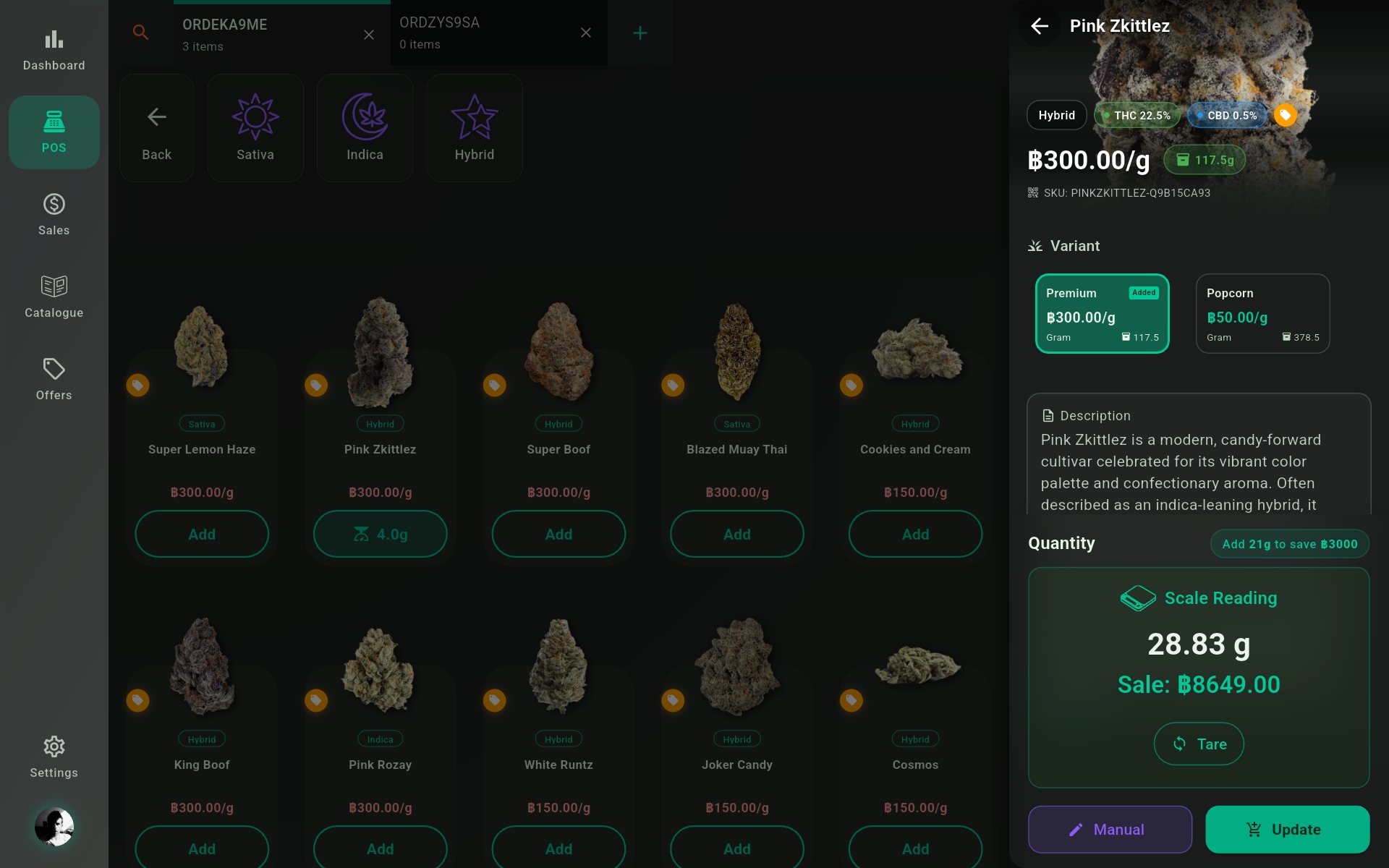
- Price items by weight, with a Bluetooth scale streaming grams into the line item in real time.
- Model strains as first-class entities with THC/CBD, effects, genetics, and lab-test metadata.
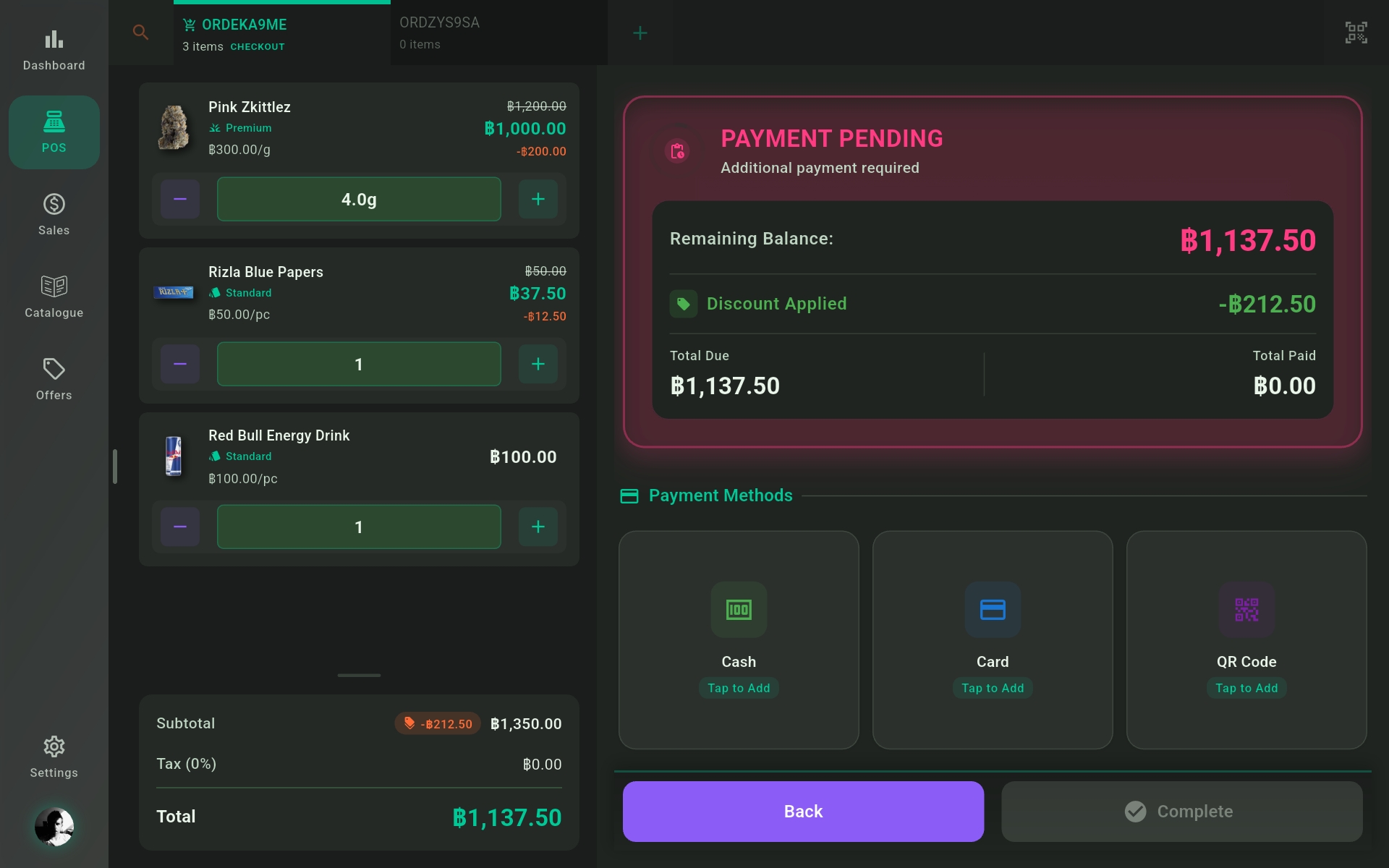
- Log every sale against a batch, a staff member, a timestamp, and (optionally) a member — automatically.
- Print compliance-ready labels from thermal printers without hand-building templates.
- Enforce age verification on every sale.
- Work offline through connectivity outages without losing sales or inventory accuracy.
- Handle the complicated payment processing landscape that follows cannabis around in most jurisdictions.
A generic POS does none of these natively. Any one of them is a manual workaround. All of them together is a full-time data-entry job.
Where generic POS platforms break for cannabis
Weight-based pricing doesn’t fit the data model
Most generic POS platforms model a sale as quantity × unit price. Cannabis flower doesn’t work that way. A customer orders “an eighth” — but the budtender scoops 3.54 grams, not 3.50 grams exactly, and the price needs to reflect that. On a generic POS, the budtender either rounds (leaking margin), hand-types the gram amount (transcription errors), or creates a new variant for every half-gram increment (unmanageable catalogue).
A specialty POS treats weight as a native transaction input. The scale streams live. The line item records the exact gram amount. The price calculates from the strain’s per-gram rate. None of that exists on Square or Clover without a custom integration, and the custom integration is a per-store engineering project.
Strain metadata has nowhere to live
Generic POS platforms have Products and sometimes Variants. They don’t have Strains. You can cram strain name into a product description, but THC/CBD, effects, genetics, and lab-test metadata end up as unstructured text — unsearchable, un-reportable, un-translatable. Ask a generic POS “which Sativa strains sold the most grams last month among members aged 25-34?” and you’ll get a blank stare.
Compliance is a manual reconstruction
Cannabis compliance requires per-sale records at a level generic retail doesn’t need. Every jurisdiction asks slightly different questions, but they all need: what batch, what weight, what strain, what staff, what timestamp, what customer. If the POS doesn’t capture that automatically, somebody does it manually — which means somebody does it wrong.
Age verification is a workflow, not a setting
On Square or Clover, age verification is either a toggle that does nothing automated or a manual ID scan flow that takes 30 seconds per sale. A specialty cannabis POS stores age verification on the member record once, flags it across every subsequent visit, and escalates to a manager prompt when needed.
Payment processing is actively hostile
This is the one most new operators don’t see coming. Square, Stripe, and most mainstream payment processors explicitly exclude cannabis from their terms of service. Operators who set up a dispensary on a generic POS often get their accounts frozen within weeks of the first cannabis transaction. Specialty cannabis POS platforms integrate with processors that actually support the industry — or handle cash-heavy workflows gracefully.
Hardware ecosystem is generic
Generic POS platforms support the generic retail hardware bundle: receipt printer, barcode scanner, cash drawer. Not Bluetooth precision scales. Not cannabis-specific label printers. Not compliance-field-aware templates. You either make it work with duct tape or you don’t make it work.
Where generic POS platforms are still fine
To be fair, generic retail POS software has real strengths that specialty platforms often lag on:
- Integration marketplaces — ten years of accumulated plugins for accounting, marketing, and payroll.
- Community knowledge — every Stack Overflow answer, every YouTube tutorial, every freelance expert.
- Pricing — many generic platforms are free at the low end.
- Hardware variety — if you want a cheap USB receipt printer, any retail POS will talk to it.
If you run a store where the product is t-shirts or sandwiches and the biggest operational question is “which colour do we restock,” a generic POS is the right tool. The trade-off flips the moment your product is measured rather than counted, and the moment regulators care about more than sales tax.
Side-by-side: where specialty POS software wins
| Capability | Specialty cannabis POS | Generic retail POS |
|---|---|---|
| Weight-based pricing with live scale | ✓ | ✗ |
| Strain as a queryable entity | ✓ | ✗ |
| Per-sale compliance logging | ✓ | Manual |
| Age verification workflow | ✓ | Manual |
| Cannabis-friendly payment processing | ✓ | ✗ |
| Cannabis-aware label printer templates | ✓ | ✗ |
| Batch and harvest tracking | ✓ | ✗ |
| Third-party integration marketplace | Growing | ✓ |
| Community content and tutorials | Newer | ✓ |
| Low-end free tier | Varies | ✓ |
Nobody’s saying generic POS platforms are bad software. The point is that the shape of cannabis retail doesn’t fit them, and the cost of forcing the fit compounds month over month.
The real cost of the mismatch
The hidden cost of running a generic POS in a cannabis dispensary isn’t the monthly fee. It’s the labour hours that accumulate in the gaps.
- 5–10 minutes per new SKU onboarded (vs under a minute on a specialty POS with AI Smart Scanner).
- 15–30 seconds per weighed sale spent on manual gram entry and price calculation.
- 1–2 hours per month reconciling spreadsheet inventory against POS records.
- A weekend per quarter reconstructing compliance data from transaction logs.
- Every staff-facing workflow trained twice: once on the POS, once on the workarounds.
For a mid-size dispensary doing 100+ transactions a day, that’s easily 20–40 hours of staff time a month. At that scale, the math on switching to a specialty POS stops being “is it worth it” and starts being “why haven’t we already.”
When the switch pays off
The honest answer: almost always, if the store’s core product is weighed or regulated differently from generic retail. The operators who stay on generic POS the longest are usually small single-location dispensaries where the owner is behind the counter every day and can absorb the workaround workload personally. The moment a second staff member is ringing up sales independently, the generic POS starts leaking money through the cracks.
Where Budy fits
Budy is a specialty POS built for cannabis dispensaries, coffee shops, and specialty retail. Weight-based pricing, strain modelling, compliance logging, Bluetooth scale integration, thermal label printing, cannabis-friendly payment rails, offline-first sync, and AI features — all native to the platform, not add-ons. For a deeper look at where Budy sits against a well-known generic POS, see our Budy vs Loyverse comparison. For the broader category, the best cannabis POS software guide lays out the ten criteria we think every operator should evaluate.
The short version
Generic POS platforms are excellent at being generic. Cannabis isn’t. Specialty POS software exists because the shape of the product, the regulation, and the hardware stack is different enough from retail boutique that forcing a fit costs more than switching.
If you’re running on a generic POS and doing daily workarounds, get in touch and we’ll show you what the workflow looks like when the software actually matches the job.