Handle PT33 Prescriptions and PT27/PT28 Reports with Budy
A step-by-step for Thai shops: check the PT33 before the sale, enforce the 30-day supply limit, record GACP batch sourcing, and prepare PT27 and PT28 reports in Budy.


A Thai counter in the prescription era has one job before the money moves: the PT33 has to be checked. Flower is still sold by weight, the batch still has to be traceable, and the shop still has to keep records it can turn into ภ.ท.27 and ภ.ท.28. This is the practical sequence for doing that in Budy. It is not legal advice. If a rule on your licence is unclear, confirm it with the authority that issued the licence.
The same sequence, written for someone comparing the product rather than walking a sale, is on the Thai dispensary page.
What Budy does on this workflow
Keep the list short, because the list is the product:
- It checks the PT33 (ภ.ท.33) prescription before the sale.
- Checkout on a controlled sale stays gated until that check is done.
- It enforces the 30-day supply limit on the sale.
- It keeps the records and prepares PT27 and PT28 reports from them.
- It records GACP batch sourcing on the product.
- It tracks strain and batch, and it sells flower by weight off the scale.
- A shop converting to a clinic uses that same till.
Budy does not issue the prescription. It does not file reports to a government portal. It does not replace a clinic licence or a practitioner on site. Those stay with the shop.
Step 1 — Put the GACP batch on the product
Do this when the flower arrives, not when a customer is already at the jar.
Each product carries its strain and its batch. The batch record is also where GACP sourcing lives: the grower source for that lot is written on the product, so a later sale does not depend on someone remembering which jar came from which delivery. THC and CBD stay with the strain. The packed date stays with the lot.
Weight-based pricing is set on the same product, as a rate per gram. Pre-packed items can sit beside it at a fixed price. The counter does not need two catalogues for that.
If the sourcing is not on the product yet, the PT27 you prepare later has nothing honest to draw from. Fix the product first.
Step 2 — Weigh the flower into the line
Most of the sale is still a scale.
The budtender taps the strain, sets the flower on the Bluetooth scale, and the grams land on the open line. Budy prices that weight from the product’s per-gram rate. Nothing is retyped between the scale and the total. A 3.5 g scoop of Pink Zkittlez at ฿300 a gram is ฿1,050, and that is the line the rest of the checks apply to.
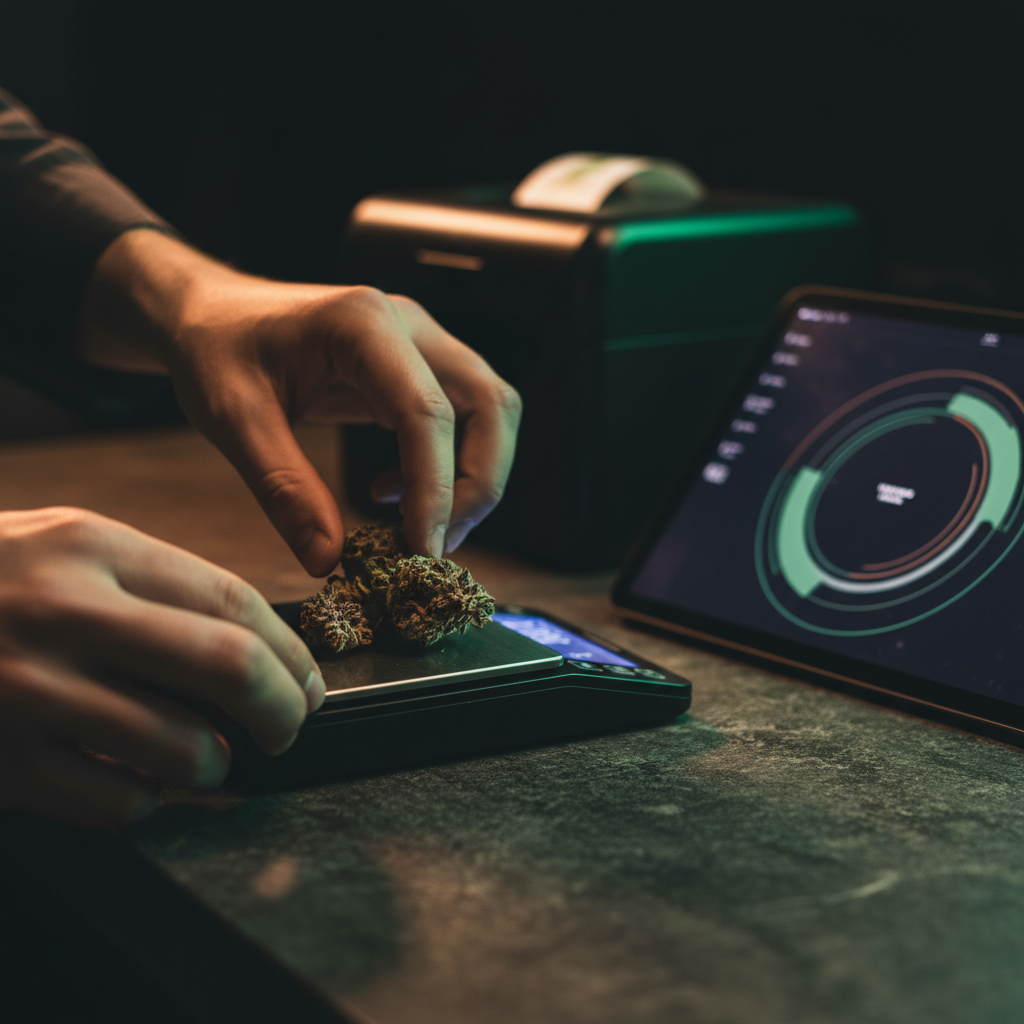
The label that prints from this line carries the strain, the weight, and the batch. Because the batch already holds the GACP source, the sticker and the stock record are talking about the same lot.
Step 3 — Check the PT33 before payment
This is the gate.
Budy checks the PT33 prescription before the sale. On a controlled product, checkout does not continue to payment until that check has passed. The customer can be holding cash, a card, or a PromptPay QR; the till still stops at the prescription.
What “checks” means here is narrow. The shop already has the prescription — a form the practitioner issued. Budy requires that check as part of the sale. Budy does not write the prescription, does not decide the diagnosis, and does not look the form up in a government registry. If the prescription is missing, expired, or not this customer’s, the sale does not get paid. Staff still have to look at the document in front of them. The till’s job is to refuse the sale until that check is recorded as done.
Do the check before you finish scooping a second jar. A line that is already weighed is easy to talk yourself into selling.
Step 4 — Hold the line to a 30-day supply
A PT33 covers at most a 30-day supply. Budy enforces that limit on the sale.
The weight on the line has to stay inside what that prescription allows. If the customer asks for more than the remaining supply, the till does not quietly round it through. You sell what the prescription still covers, or you do not sell. The limit is on the supply the prescription authorises, not a separate house rule you invent at the jar.
This replaces the old habit of a flat daily cap that ignored the prescription. The number that matters is the 30-day supply on the PT33 in front of you.
Step 5 — Keep the record, then prepare PT27 and PT28
Once the prescription is checked, the limit holds, and the customer pays, the sale has already written its record: strain, batch, weight, and the fact that the PT33 was checked before payment. You should not be reconstructing that from a notebook at close.
Those records are what Budy uses to prepare the two reports:
- ภ.ท.27 is the source report — where the cannabis came from. It draws on the GACP batch sourcing you recorded on the product when the lot arrived.
- ภ.ท.28 is the use-and-sale report — what the shop used or sold. It draws on the sales you actually rang.
Preparing a report is not the same as filing it. You review what Budy prepared, reconcile it with the deliveries and the prescriptions you kept, and you submit it yourself. Budy does not send ภ.ท.27 or ภ.ท.28 to a government portal, and it does not tell you the filing was accepted. If a month does not tie out, the gap is still yours to explain.

A useful close-of-day read is short. For each controlled sale: was the PT33 checked before payment, was the weight inside the 30-day supply, and does the batch on the receipt match a product whose GACP source is filled in? If those three are true, the monthly reports are a review. If they are not, you are back to the notebook.
Shops converting to a clinic
Some shops are not staying shops. The counter they need on the other side of that change is the same one.
A shop converting to a clinic keeps prescription gating at checkout, strain and batch tracking, weight-based sales, GACP batch sourcing on the product, and PT27/PT28 reports prepared from the records. You do not park the till and start a second system for the flower. Budy does not become the clinic licence, the practitioner, or the clinical record. It stays the point of sale that will not take payment until the PT33 is checked.
If the conversion is still on paper — new premises standard, a practitioner on the roster, a fresh licence application — the till does not complete any of that. It only means the sale you ring next month can follow the same steps as the sale you ring this week.
One sale, end to end
Put the pieces on a single customer so the order is obvious.
- The lot is already on the product, with its strain, its batch, and its GACP source.
- The customer asks for Pink Zkittlez. The flower goes on the scale. The line prices itself from the grams.
- Staff check the PT33. The till will not take payment until that check is done.
- The weight is inside the 30-day supply on that prescription. If it is not, the line changes before anyone pays.
- Payment happens. The label prints from the batch. The sale record is written.
- At month end, ภ.ท.27 and ภ.ท.28 are prepared from those records. The shop reviews them and files them.
That is the whole counter. Everything else — a second language on the receipt, a printer model, a card machine — can wait until this sequence is boring.
Questions staff actually ask
Does Budy check PT33 prescriptions before the sale? Yes. Budy checks the PT33 (ภ.ท.33) prescription before the sale and gates checkout on that check. Payment on a controlled sale does not go through until the prescription has been checked. Budy does not issue the prescription, and it does not send it to a government system.
Can Budy prepare PT27 and PT28 reports? Yes. Budy keeps the sourcing and sale records and prepares ภ.ท.27 and ภ.ท.28 from them. ภ.ท.27 is the source report. ภ.ท.28 is the use-and-sale report. The shop reviews the reports and files them. Budy prepares the reports; it does not submit them to a portal.
Does Budy enforce the 30-day supply limit? Yes. A PT33 prescription covers at most a 30-day supply. Budy enforces that limit on the sale so the weight you ring up stays inside what the prescription allows.
Can a shop converting to a clinic keep using Budy? Yes. A shop converting to a clinic uses the same till: prescription gating at checkout, strain and batch tracking, weight-based sales, GACP batch sourcing recorded on the product, and PT27/PT28 reports prepared from the records. Budy does not replace a clinic licence or a practitioner.
Where to read next
The Thai dispensary page is the product view of the same counter: the till, the prescription check, and the reports, in one place. If you want to see it on your own jars, email support@budy.app and we will walk a sale with you.