Cannabis Inventory Management: From Bud Jar to Receipt in One System
How a cannabis inventory management system tracks flower from intake to sale: batch receiving, gram-level deduction, and seed-to-sale reconciliation.

Ask ten dispensary owners where their operational pain lives, and nine will say inventory. Not sales. Not compliance. Not staff. Inventory. Because inventory is where every other part of the business meets, and it’s where every mistake made elsewhere eventually surfaces.
A cannabis inventory management system is not a spreadsheet with extra columns. It’s the ledger that tracks flower from the moment a batch arrives at the back door to the moment a gram leaves the counter on a customer’s receipt — with every intermediate step captured automatically. Done well, it reconciles itself. Done badly, it’s a weekend of detective work every month.
This article walks through what a real cannabis inventory management system does, why seed-to-sale cannabis POS data has to live in one database, and how Budy handles the flow end to end.
The journey of a gram
Start at the back door. A new batch of a strain — call it Pink Zkittlez — arrives from the cultivator. The supplier hands over a shipment: 500 grams, lab-tested at 22% THC, harvest date March 18, batch ID BATCH-2026-0318-PZ. A cannabis inventory management system captures that intake as one event:
- Product: Pink Zkittlez (strain entity, not just a text name)
- Batch: BATCH-2026-0318-PZ
- Harvest date: 2026-03-18
- Lab metadata: 22% THC, 0.4% CBD, tested by Lab X on 2026-03-22
- Weight received: 500.0 g
- Supplier: Green Roots Co-op
- Received by: staff member, timestamp
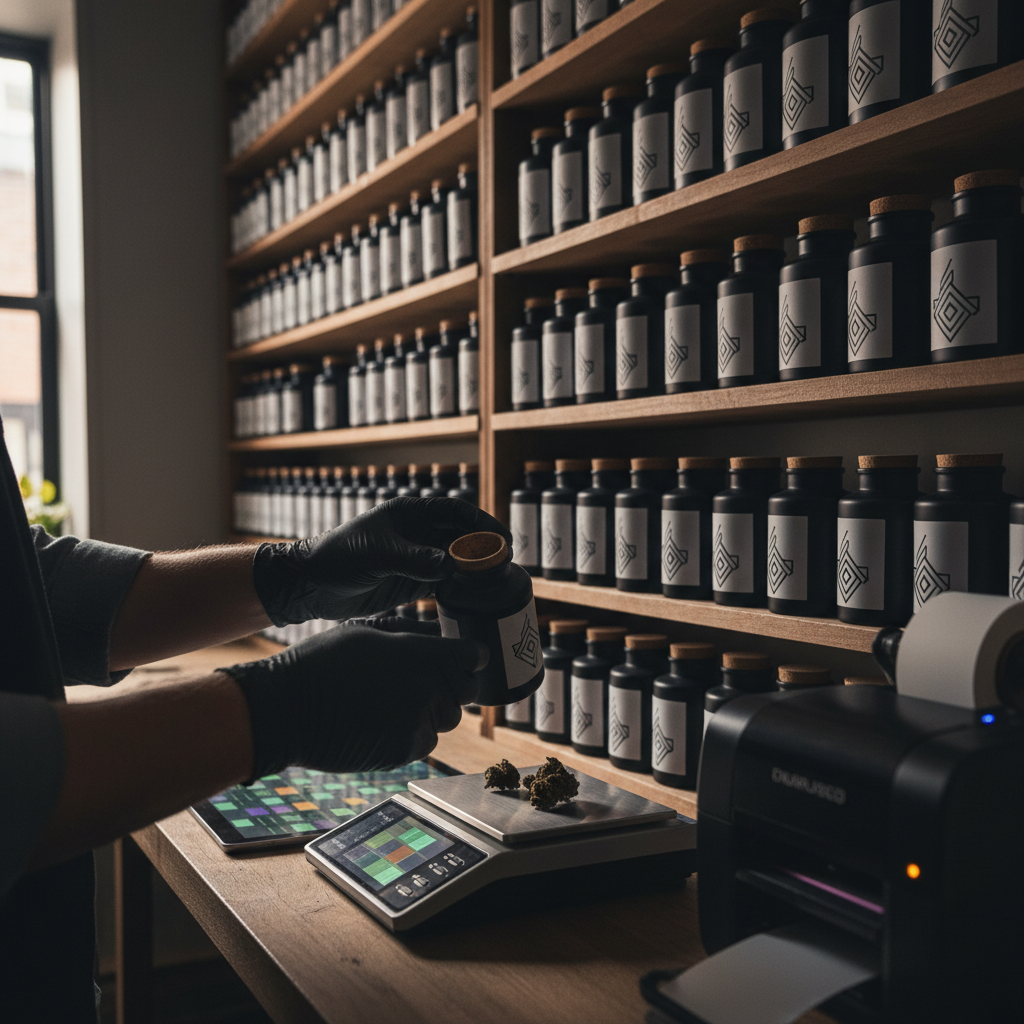
From that moment on, every gram of that batch has a traceable history. It gets jarred (say, ten jars of 50 g each). Each jar gets a QR/barcode label printed on the Niimbot, tied to the same batch ID. Budtenders scoop from those jars into customer orders. Every sale decrements the jar and the batch by the exact weighed grams — not by unit count, not by rounded estimate.
At any moment, an operator can pull up BATCH-2026-0318-PZ and see: received 500.0 g, sold 347.4 g across 82 transactions, current stock 151.8 g, waste logged 0.8 g, reconciled through yesterday. That’s what seed-to-sale means in practice.
Why gram-level deduction matters
The single biggest reason generic POS platforms fail dispensaries is this: they deduct inventory by unit count, not by weighed amount. If a customer buys “an eighth,” the generic POS subtracts 1 from the “eighth” inventory. Never mind that the budtender actually scooped 3.54 grams, or 3.62 grams, or 3.47 grams. The actual flower left the jar in grams. The generic POS pretends it left in eighths.
Over a month, that gap compounds. Some eighths weigh 3.4 g, some 3.6 g. Some customers buy “a gram” but the scoop is 1.07 g. The jar runs empty before the POS says it should — or the POS says the jar is empty when there’s still 40 grams sitting on the shelf. Either way, the store’s inventory is wrong.
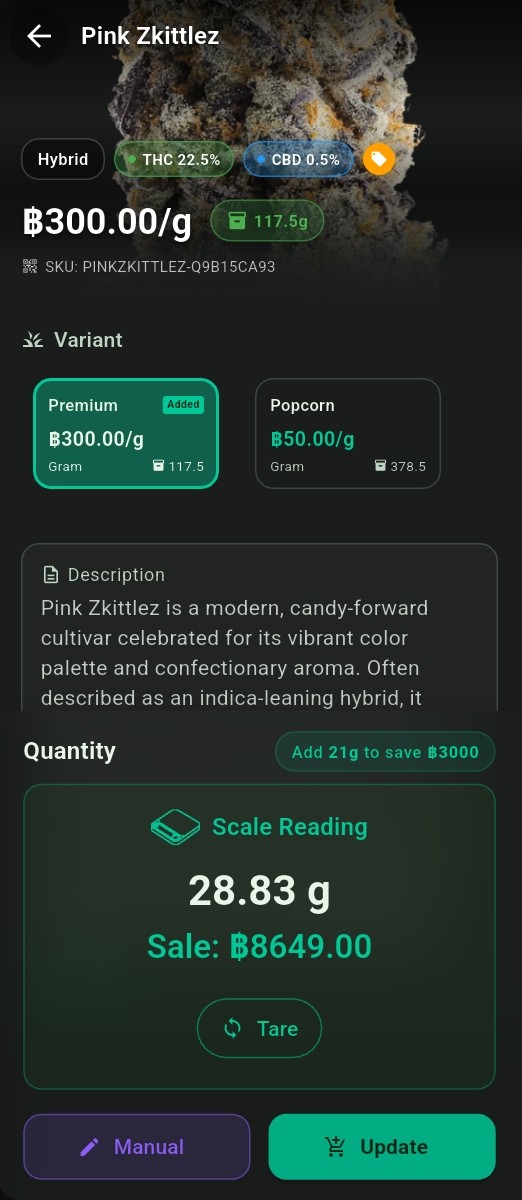
A real cannabis inventory management system deducts in grams from the jar, the batch, and the strain on every sale. The gram reading comes from the Bluetooth scale, streamed into the line item automatically — no typing, no rounding, no guessing. The jar goes empty exactly when it’s empty.
What a receipt tells you about your inventory system
A receipt is the smallest artifact a dispensary produces. It’s also a diagnostic for the entire inventory stack. A good receipt shows: strain name, exact gram weight, per-gram price, batch ID (optional), total, and the staff member who rang it up. A bad receipt shows: a SKU code, a flat unit price, and a quantity of “1.”
If your POS can’t produce the first kind of receipt, it also can’t produce a real reconciliation report — because the data that would make the receipt meaningful was never captured at the line level.

A mobile receipt with line-level detail. The invoice number, the date, and the staff-aware audit trail are all written to the inventory ledger at the moment of sale.
The four inventory operations a dispensary runs every day
Receiving
New stock arrives. A cannabis inventory management system logs it as a batch with weight, supplier, harvest date, lab metadata, and received-by staff. Jars are printed with QR labels tied to the batch. The whole process takes a couple of minutes for a shipment that would take a spreadsheet-based workflow half an hour.
Deduction on sale
The primary inventory event. Every weighed sale deducts grams from the jar, the batch, and the strain. Non-weighed items (edibles, pre-rolls by count, concentrates by unit) deduct by quantity. Mixed carts handle both. All of this is atomic — the sale doesn’t commit until the inventory writes succeed.
Waste and adjustment logging
Things happen. A jar tips over. A budtender drops a gram. A batch fails a re-test and has to be quarantined. A proper inventory management system has first-class events for waste logging (with reason codes and manager approval) and stock adjustments (for transfers between stores, or for correcting counting errors). These are audit-visible, not just database edits.
Reconciliation and counting
Periodically — nightly for tight shops, weekly for most — staff count physical stock and compare to system stock. A purpose-built cannabis inventory system makes this a scanner-and-scale workflow: open a count session, scan each jar’s label, weigh it, enter the number, and the system flags variances. Discrepancies show up as specific questions, not mysterious end-of-month gaps.
Multi-terminal consistency is non-negotiable
Three budtenders, three terminals, one busy Saturday. All three are selling Pink Zkittlez from the same jar. The inventory stack has to:
- Let each terminal see the current stock in near-real-time.
- Decrement the jar correctly no matter which terminal clears the sale first.
- Prevent over-selling when the jar crosses zero.
- Stay consistent even if one terminal briefly loses network.
A single-device POS handles this trivially. A cloud-only POS with intermittent connectivity does not — it can double-sell the last gram of a jar because two terminals both thought it was in stock.
Budy’s multi-terminal sync runs through ObjectBox Sync Server on the local network. Each device has its own full local database. Writes propagate to peers in under a second. When a jar crosses zero, every other terminal sees the update before the next budtender taps it.
Online and in-store share one inventory
If your dispensary runs a web shop — online ordering, pickup, or delivery — the inventory has to be one ledger, not two. If the web shop has its own database that sync to the POS once an hour, it will accept orders for flower that’s already gone. The customer shows up, the order can’t be filled, the refund costs you twice.
A proper cannabis inventory management system writes every sale to a shared sync layer. The web shop reads live stock. The POS writes live deductions. Online orders decrement the same counters that in-store sales decrement. When a strain sells out at the counter, the web shop blocks the next online checkout for it within the second.
Where seed-to-sale cannabis POS data lives
The phrase “seed-to-sale” gets thrown around a lot. In practice, a seed-to-sale cannabis POS is one where every gram has a traceable history from batch intake to customer receipt, captured automatically, queryable at any time. The questions a seed-to-sale system has to answer:
| Question | Answerable in seconds? |
|---|---|
| Which batch is this jar from? | ✓ |
| How many grams of BATCH-X sold last month? | ✓ |
| Which staff member sold this specific line item? | ✓ |
| How much waste was logged against this strain? | ✓ |
| What’s the sell-through rate for Sativa strains? | ✓ |
| Show me every transaction tied to customer X. | ✓ |
| Which jars are still on shelf from a failed lab re-test? | ✓ |
If your current POS can’t answer all seven in seconds, you don’t have a seed-to-sale cannabis inventory management system — you have a cash register with a spreadsheet bolted on.
Reconciliation becomes a ten-minute ritual
The end-of-day close on a well-instrumented cannabis inventory management system is intentionally boring. Staff pull a variance report. The system lists jars where physical count (weighed) differs from system count (expected) by more than a tolerance. For most jars the variance is zero; for a few it’s a few tenths of a gram that match expected scoop drift. The one or two real discrepancies get investigated on the spot, not discovered three weeks later.
Compare to a manual workflow: an hour of spreadsheet work, a nagging feeling that something’s off, and a monthly “inventory meeting” that accomplishes little. Over a year, the boring workflow saves hundreds of hours and surfaces problems while they’re still small.
Where Budy fits
Budy’s cannabis inventory management system is built into the POS, the admin dashboard, and the web shop on one ObjectBox-backed sync layer. Receiving is a scan-and-weigh workflow. Every sale deducts in grams from jar, batch, and strain. Waste and adjustments are first-class events. Reconciliation runs on scanner-and-scale input. The online storefront reads live stock, so it never oversells. Multi-location support means a chain has one master catalogue and live per-store inventory.
For the broader picture of how this fits into a full cannabis dispensary management system, we’ve written up the four layers — catalogue, members, compliance, online — that sit above the inventory layer. For the hardware side of how grams get from the scale into the inventory system, the Bluetooth scale integration guide covers it in detail.
The short version
Cannabis inventory management is the core ledger of a dispensary. Generic POS platforms treat inventory as a unit-count problem. Cannabis is a grams problem. The difference compounds daily.
If you’re running a dispensary and spending your Sundays reconciling jars, get in touch and we’ll walk you through what a live-sync, gram-level inventory system feels like on real hardware. It’s the kind of change you only appreciate after the first month — when you realise you haven’t thought about reconciliation in weeks.