Cannabis Dispensary Management System: Beyond Just a POS
A cannabis dispensary management system is more than a cash register. How inventory, members, compliance, and back-office reporting fit together.


When operators ask us “do you have a cannabis POS?” — we usually answer with another question. Do you want a cash register, or do you want a cannabis dispensary management system?
The two sound similar. They’re not. A cash register rings up sales. A management system runs the whole store: inventory, members, compliance, reporting, online presence, multi-terminal staff workflows, back-office analytics. The POS is one surface of that system — the one the budtender touches — but it’s connected to everything else.
If you’re shopping for marijuana dispensary software in 2026, understanding that distinction is the difference between buying a tool you’ll outgrow in six months and a platform you’ll still be running five years from now.
What a “management system” actually means
A cannabis dispensary management system is the full operational stack a store needs to run end to end. That’s usually:
- Shop-floor POS — the app budtenders use to ring up sales, weigh flower, and print labels.
- Inventory and catalogue management — receiving, stock levels, reconciliation, waste logging, batch tracking, supplier records.
- Member and loyalty engine — customer profiles, purchase history, age verification, tier-based rewards, cart-aware offers.
- Compliance layer — per-sale logging, batch traceability, staff accountability, audit-ready reports.
- Back-office admin — dashboards, multi-location configuration, pricing rules, staff permissions, reports.
- Online presence — a customer-facing web shop, online ordering, delivery or pickup workflows.
- Hardware integrations — scales, printers, scanners, receipt printers, cash drawers, secondary displays.
- Sync and offline infrastructure — the plumbing that keeps every terminal, tablet, phone, and back-office screen consistent.
A cannabis POS that only covers the first item on that list leaves you gluing together six or seven other tools yourself. A proper cannabis dispensary management system delivers all of them on one data layer, with no seams.
Why gluing tools together fails
Most operators start with a cheap POS and add tools as they grow. A year in, the setup looks like: retail POS for sales, Excel for inventory, Google Sheets for staff scheduling, Mailchimp for member blasts, a web-store builder on a subdomain, and a batch-tracking spreadsheet that nobody updates.
Every one of those tools has its own login, its own data model, and its own export format. Customer records drift between them. Inventory numbers disagree. A strain that sold online shows “in stock” in the POS because the sync is one-way or delayed or broken. When compliance asks for the Q3 sales log, somebody spends a weekend merging CSV files.
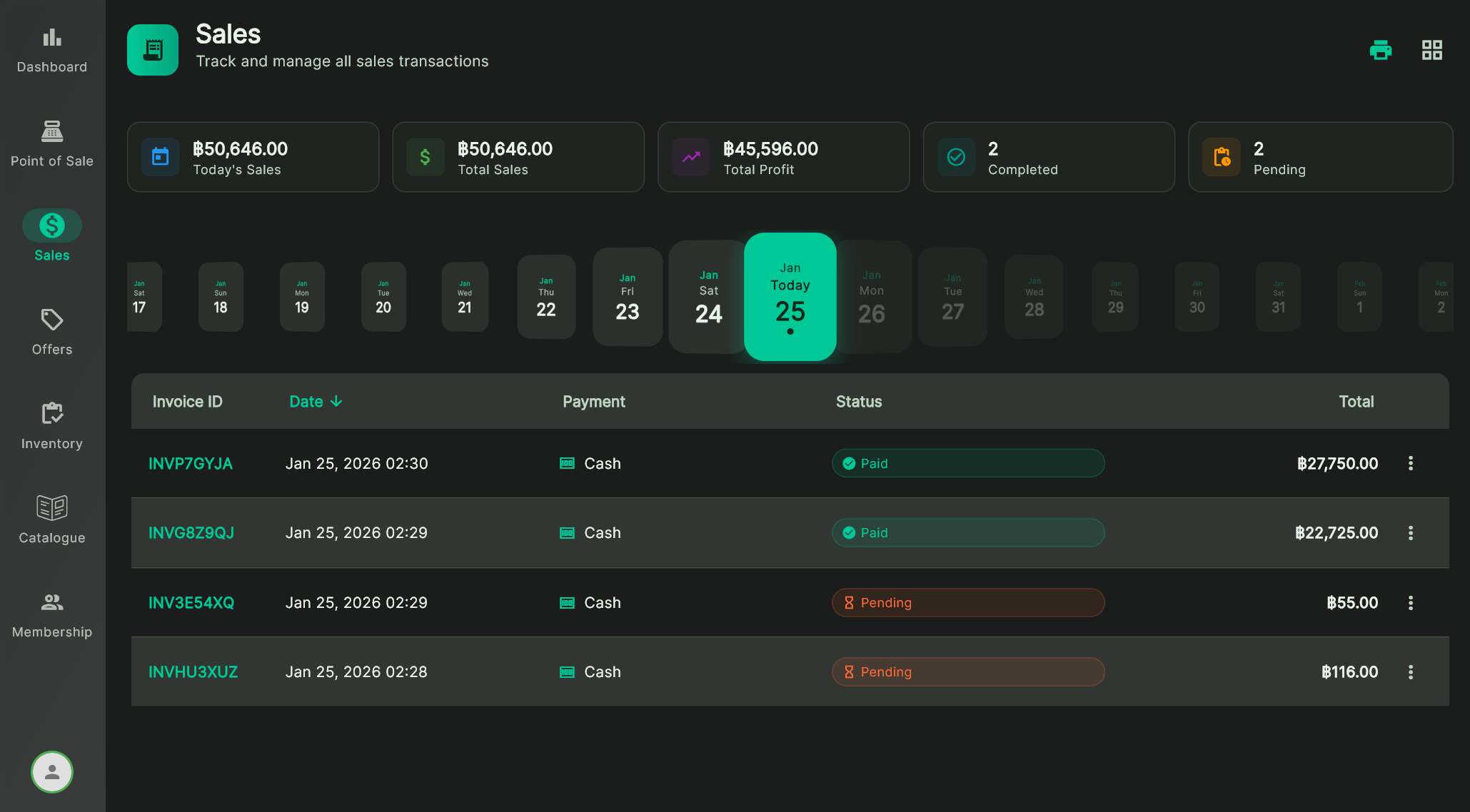
A unified cannabis dispensary management system removes the seams. One database model holds products, strains, inventory, members, orders, staff, and permissions. Every surface — POS, admin, web shop — reads and writes from the same sync layer. When a sale clears on the shop floor, the stock level updates on the admin dashboard, the web shop blocks over-selling, and the compliance log writes itself. No glue code, no drift, no weekend CSV merges.
Offline-first matters more than you think
The most under-appreciated piece of marijuana dispensary software is what happens when the network drops.
A cloud-only management system collapses the moment your ISP hiccups. Budtenders can’t ring up sales. The back office can’t see live inventory. The web shop keeps accepting orders for flower you’ve already sold. When connectivity returns, you’re left reconciling by hand.
Budy’s cannabis dispensary management system is offline-first by design. ObjectBox runs as the primary local database on every device. The backend is a sync target, not the system of record. A store keeps operating through multi-day outages, and every terminal stays consistent with the others on the local network — no internet required. When connectivity returns, the cloud and web shop catch up automatically.
Operators only appreciate this after their first major outage. The ones who planned for it keep trading. The ones who didn’t close the doors for the day and eat the lost revenue.
The four layers of a real dispensary management system
Layer 1: Catalogue and inventory
A cannabis inventory management system is where most generic POS platforms break down first. A cannabis catalogue needs: strain-level records with THC/CBD and effects, product variants with flexible attributes (grams, potency, lab dates, harvest batches), category hierarchies that match how customers browse, collections that match how you merchandise, and stock counts that deduct in grams — not units — on sale. Batch and harvest tracking need to be queryable, not buried in a description field.
Layer 2: Members and loyalty
Dispensaries survive on repeat business. A proper management system ties every sale to a member (if they want to be one), holds age verification on file, tracks points or tier status, and applies loyalty rewards at checkout automatically. Budtenders see “usual strain” and “last visit” at a glance, so the conversation picks up where it left off.
Layer 3: Compliance and reporting
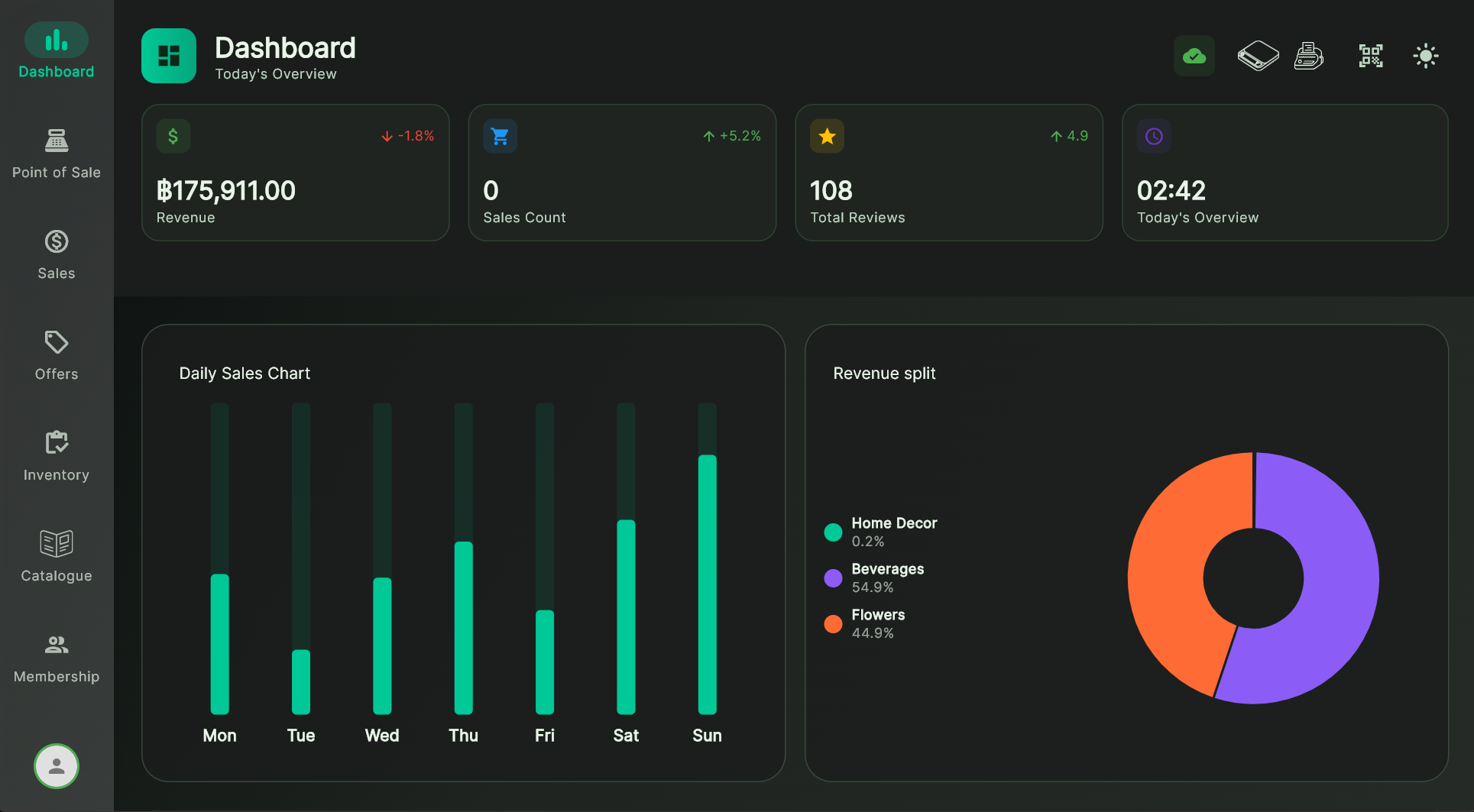
Compliance data should write itself. Every line item tied to strain, batch, staff, timestamp, customer, and any discount applied. Audit reports come out of the system in minutes, not reconstructed from paper. Staff accountability is a column in the ledger, not a separate log.
Layer 4: Online and multi-location
A modern dispensary management system ships a customer-facing web shop on the same data layer as the POS. Orders placed online push notifications to the in-store POS. Status changes push back to the customer’s device. Inventory and pricing are one database, not two. And if you open a second store, you configure it — you don’t migrate to a different platform.
What to look for when evaluating
A cannabis dispensary management system buyer’s checklist looks different from a POS checklist. For the POS-specific criteria — weight-based pricing, scale integration, offline mode — our best cannabis POS software guide covers them in depth. For the management-system side, press every vendor on:
| Capability | Why it matters | Sanity-check question |
|---|---|---|
| One database, multiple surfaces | Drift kills data | “Show me inventory updating on admin after a POS sale” |
| Offline-first primary storage | Outages happen | “Disconnect Wi-Fi. Can I still sell?” |
| Real-time multi-terminal sync | Busy nights | “Two tills, same strain — does stock decrement correctly?” |
| Strain as a first-class entity | Cannabis specifics | “Can I report on sell-through by THC range?” |
| Built-in web shop on same sync | No third-party glue | “Does an online order appear on the POS without a CSV?” |
| Compliance logs per sale | Audits happen | “Pull me a batch-level sales report for last month” |
| Multi-location / multi-tenant | Future growth | “Open a second store — what changes?” |
| Exportable data | No lock-in | “Can I walk out with my member database?” |
If a vendor dodges any of these or needs to “get back to you,” that’s signal.
Where Budy fits
Budy is built end-to-end as a cannabis dispensary management system. Three surfaces — the POS app, the admin dashboard, and the per-tenant web shop at {your-store}.budy.app — share one sync layer. Compliance, inventory, loyalty, members, hardware, and reporting are features of the same platform, not integrations between different platforms.
We’re honest about where we’re newer than legacy vendors: fewer pre-built compliance templates for niche jurisdictions, a growing third-party integration marketplace, and less community content. For operators who value a unified platform, offline resilience, modern AI agents, and honest data portability, it’s the right trade.
The bottom line
A cannabis POS is a cash register. A cannabis dispensary management system is the operating system for a dispensary. If you’re only evaluating cash registers, you’ll replace your software in eighteen months. If you’re evaluating management systems, the shortlist is smaller — and the conversation is different.
Worth having that conversation? Get in touch and we’ll show you how Budy’s POS, admin, and web shop work as one system. The comparison with Loyverse covers where a unified management system pulls ahead of a generic POS, and the Bluetooth scale integration page covers the hardware story in more detail.